Rebuilding The Consumer Journey: A Case Study

The consumer experience in health care is often, and erroneously, seen as customer service and relegated to a “front-desk” issue. In reality, it’s the linchpin to a critical performance loop created by customer service, consumer experience, and consumer engagement working to create a great consumer journey—which can be either a major contributor or a major detriment to revenue and financial sustainability. And the changing role of the chief financial officer (CFO) includes involvement with a wide range of executive initiatives beyond just managing the costs.
The consumer journey, which is the sum of every interaction a consumer has with any organization over time, determines whether a consumer becomes a promoter or a detractor of the services they receive and the organization from which they received those services. Investments to support, track and manage that process have costs, which the CFO manages, but there are also strategic decisions in investing in one solution or approach over another that the CFO is increasingly participating in, along with the rest of the executive team.
The consumer journey is also an indicator of whether the organization will capture repeat business or lose it. And that is part of the CFO’s expanding sphere of influence. For health and human service provider organizations, engagement and retention are particularly critical to clinical outcomes, which drive payer contracts and revenue under value-based reimbursement. Nowhere is the CFO’s role more relevant, and nowhere is collaborative engagement with the rest of the leadership team more critical.
This month, we are looking at investments that were made in 2023 to support the consumer journey at Easterseals MORC, a Michigan-based, $125 million non-profit behavioral health and human services organization that delivers a continuum of integrated physical, behavioral, and community-based services through 16 locations, as well as 35 school-based locations. The organization employs over 1,000 staff and serves over 25,000 individuals and families annually.
The Challenges
Easterseals MORC serves a population where 80% of consumers are uninsured, underinsured, or Medicaid recipients, many of whom lack access to high-speed internet, modern devices, or private digital spaces for care. The organization was also faced with a behavioral health workforce shortage and struggled to recruit and retain social workers, counselors, and case managers—especially for severe and persistent mental illness populations.
Additional pressures included rising consumer expectations for accessibility, convenience, and personalized service; increased privacy and cybersecurity risks (including Health Insurance Portability and Accountability Act (HIPAA) compliance challenges); and the need to preserve in-person service models while scaling virtual and technology-enabled care.
These forces required a rethinking of engagement, access, and workforce support—anchored in scalable, consumer-centered technology solutions. Strategic decisions in direction and approach are involving CFOs earlier in the process as organizations examine a broad remaking of their workflows and consider the necessary investments.
Strategic Actions
The organization executed a multi-phase digital transformation that rebuilt the consumer journey from first contact to ongoing care, using four major engagement platforms:
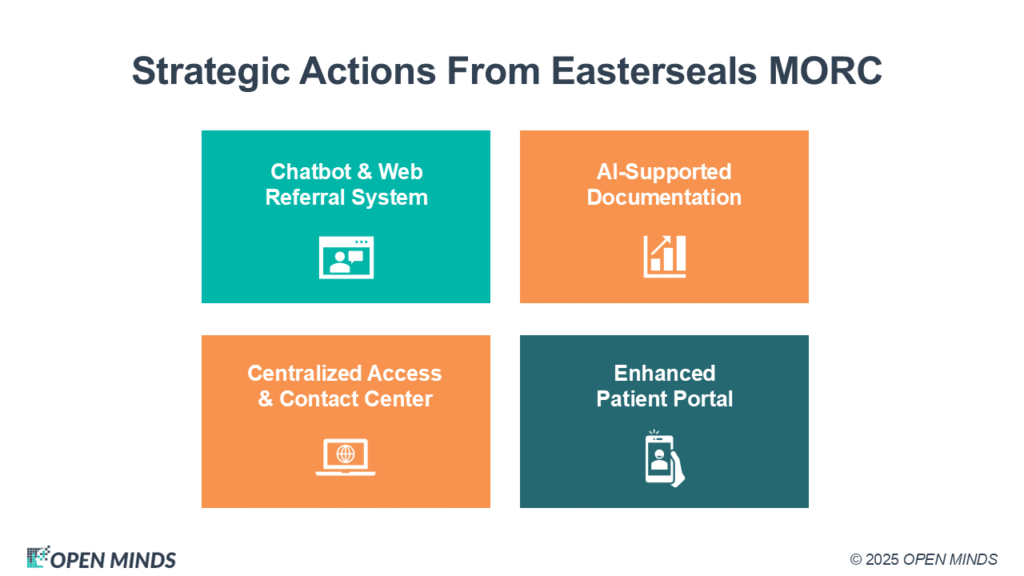
- Chatbot and web referral system: The organization added 24/7 webchat with escalation to live agents and a new online referral form that feeds directly into the EHR, shortening the time from referral to intake and automatically flagging crisis keywords (e.g., “suicide”) for rapid response. The goal was to streamline consumer contact, enhance engagement, and move more information more quickly to be actionable by teams.
- Centralized access and contact center: The organization converted a basic call center into a 10-agent omnichannel contact center integrating phone, chat, web, email, and fax. The center links directly with the electronic health record (EHR), allowing staff to recognize repeat callers, personalize interactions, and track all inquiries. Real-time dashboards monitor dropped calls and wait times so managers can intervene immediately. The investments were intended to have long term benefits as well as immediate effects.
- AI-supported documentation: The organization piloted voice-based natural-language understanding software that summarizes therapy sessions and drafts notes, cutting documentation time and freeing clinicians to focus on consumers.
- Enhanced patient portal: The organization enabled mobile access to health records, secure messaging, labs, medications, and appointment scheduling, giving consumers greater control and transparency. These tools are increasingly what consumers expect in their health care journey.
The Outcomes
Easterseals MORC achieved measurable improvements across access, engagement, and workforce efficiency, including:
- 10 full-time contact center agents now handle more than 4,300 records annually, with 3,400 direct service requests and increasing web referrals (3% within months of launch).
- Consumer satisfaction ratings reached 96% for provider care and 94% for overall experience, indicating strong consumer acceptance of digital and hybrid engagement models.
- Telehealth utilization stabilized at 27% of all service encounters, supporting care continuity during and after the pandemic.
- The AI documentation pilot improved clinician satisfaction and efficiency—AI-generated notes reduced documentation time and helped retain staff by restoring focus on therapeutic interaction.
- The portal’s mobile optimization improved convenience and reduced administrative inquiries, enhancing consumer autonomy in care management.
Leadership Advice
Easterseals MORC’s experience demonstrates how mission-aligned technology adoption—anchored in accessibility, personalization, and clinical integrity—can transform consumer engagement.

Provider organization executives who are looking to replicate this approach—and success—should do so with a focus on leadership, partnership quality, and risk tolerance in digital transformation. Easterseals MORC noted a few specifics about this approach.
- Seek partners, not vendors: Technology adoption should center on mission alignment and shared learning. Vendors must bring industry best practices and a willingness to work with provider organizations on evolving needs, not just tools. As CFOs manage costs, and projections, they are engaging more broadly with the partnership process to understand the value of partnerships as well as the dollar value.
- Empower bold executive teams: Success requires leadership willing to embrace innovation and data and to even embrace failure on the path to success. There is value to be gained when executives embrace risk-taking and innovation together. CFOs joining in innovation brings their perspective to the process.
- Invest in workforce, mission, and technology together: Tools must enhance human capacity, not replace it. And it’s important to always link technology to mission outcomes. Every system should deepen consumer connection and clinician focus on care, not just operational efficiency.
Executives who are pursuing better consumer engagement should seriously consider technology as a path forward—but only if they are capable of building a model for human-centered digital transformation, vetted by their teams, including leadership and staff. That way, well-integrated tools, guided by mission-driven leadership, can simultaneously elevate consumer engagement, staff efficiency, and organizational resilience, using the right tools through the right investments at the right costs.