Chief Financial Officers: Strategic Guides For Consumer Experience Technology Investments

In health and human services, the consumer experience can be a defining measure of competitiveness and a direct driver of financial performance. Today’s consumers expect smooth access to care, transparent billing, and responsive communication, enabled by a digital front door and supported by 24/7 access to information. The organizations that deliver on those expectations will be in the running for higher retention, stronger engagement, and improved outcomes.
Today’s chief financial officers (CFOs) can support the sustainability of their organizations by using the resulting data in two ways—by participating in the strategic decisions that result in investments that support consumer engagement with technologies that enhance the consumer journey and in negotiations with payers for contracts that will sustain the organization over time, supported by data that proves the mission and tracks outcomes and costs.
The CFO’s Leadership Role
CFOs are uniquely positioned to translate consumer experience into financial outcomes. Their oversight of technology budgets and return on investment (ROI) analyses gives them leverage to shape investment decisions. Collaborating with executive teams throughout the decision-making process for choosing new investments expands the CFO’s portfolio. Leading CFOs who are actively partnering with leadership to drive success across their teams should find answers to four strategic questions:
- Which consumer technologies are generating measurable improvements in access, satisfaction, or retention that support both outcomes and the bottom line by translating consumer experience into financial success?
- How can we align tech-enabled engagement with payer incentives and value-based care contracts?
- Where are the redundancies or underutilized tools in our current tech investments?
- What metrics can demonstrate ROI in both consumer outcomes and organizational efficiency?
By treating consumer engagement as a capital investment, CFOs can drive a sustainable transformation that supports both mission and margin. By understanding and participating in the strategic components of these investments toward the long-term sustainability of their organizations, CFOs enhance their roles and add value beyond managing costs.
The Consumer-Driven Tech Landscape
As consumer expectations evolve, technology plays a critical role in meeting those expectations by creating seamless, personalized, and accessible interactions. Consumer engagement solutions offer six key capabilities:
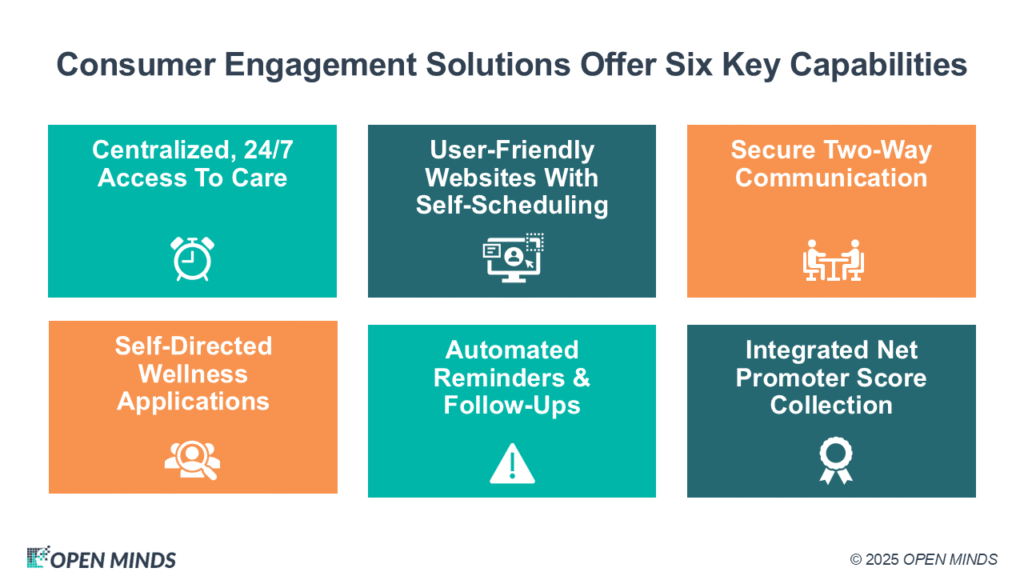
- Centralized, 24/7 access to care: A single, digital front door for all services, whether scheduling, messaging, or telehealth, is the epitome of convenience and is what consumers increasingly expect to see in their health care journey, as that is what is already available to them elsewhere.
- User-friendly websites with self-scheduling and pre-visit forms: Reducing friction enhances satisfaction, cuts administrative workload, and supports engagement and retention.
- Secure two-way communication: Portals and messaging systems enable consumers to exchange information, access bills, renew prescriptions, and view their health records in real time. Asynchronous communication means questions can be asked and answers can be given at convenient times.
- Self-directed wellness applications: Encouraging continuous engagement beyond episodic visits improves care access and long-term outcomes.
- Automated reminders and follow-ups: Improving attendance and adherence, optimizing clinician schedules, and reducing no-shows controls for wasted cost and optimizing the scarcest and most valuable asset in a health care provider organization: staff time.
- Integrated Net Promoter Score (NPS) collection: Embedding feedback loops directly into workflows to track and improve satisfaction delivers actionable metrics for both consumer experience initiatives and value-based contracts.
Investments into tools with each of these capabilities create a measurable impact on operational efficiency, staff productivity, and financial sustainability. The key is to remember that their effectiveness depends on CFOs having a clear ROI mandate and thoughtful integration supported by training and outreach after adoption. Engaging with a rapidly changing market to achieve a competitive advantage is enhanced by shared decision making across executive teams that allows insights and information to shape responses as circumstances evolve. CFOs who can respond with agile and nimble leadership can enhance the succes of their teams and help guide their organizations to sustainability even during the most turbulent times.
Building The Digital Front Door
The concept of a digital front door has become a cornerstone of health care consumer experience strategy. For CFOs, the challenge is to align technology investments with measurable business outcomes while ensuring a seamless consumer journey.
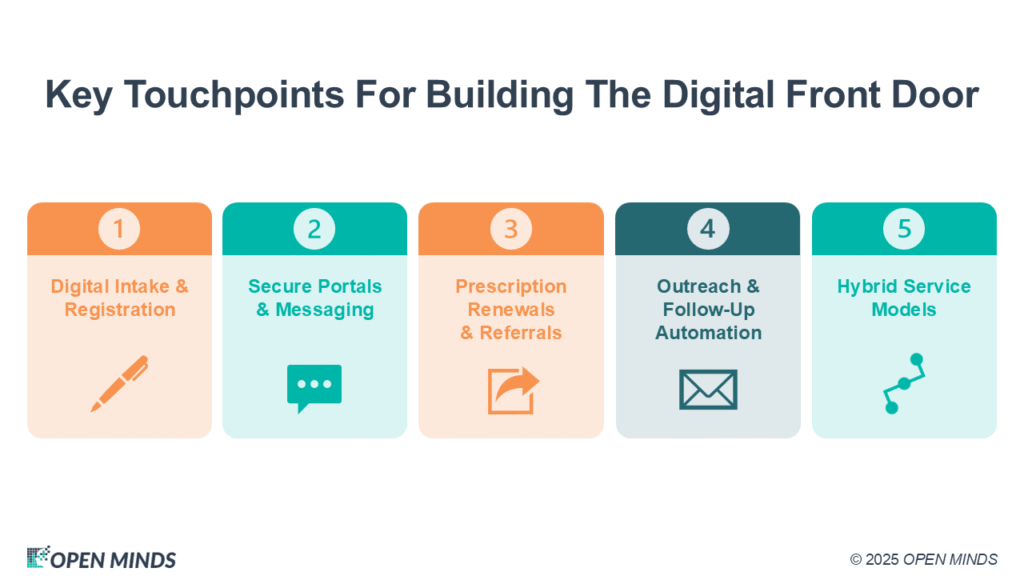
Key touchpoints in this continuum include:
- Digital intake and registration: Streamlining data entry reduces administrative time and errors and empowers staff and consumers to interact effectively and efficiently at this critical step in the consumer journey.
- Secure portals and messaging: Facilitating real-time, two-way communication builds trust and speeds problem resolution. Consumers can ask questions and expect answers in a format that is convenient to them and staff can triage interactions as needed.
- Prescription renewals and referrals: Digital tools for these processes ensure consumer convenience and close critical care loops. Interoperability with community service providers provides visibility into whole person care and the consumer journey.
- Outreach and follow-up automation: Proactive reminders, check-ins, and personalized health prompts drive engagement and retention, supporting outcomes and optimizing schedules.
- Hybrid service models: Integrating in-person, telehealth, and remote monitoring provides flexibility without compromising continuity. Meeting people where they are enhances engagement and retention and supports work-life balance for staff.
Together, these elements create a unified experience that aligns consumer convenience with clinical and financial goals.
Mapping Consumer Interaction Points
To effectively manage consumer experience, executives must visualize the full ecosystem of interaction—from awareness to post-care communication. There are five tech investments to consider:
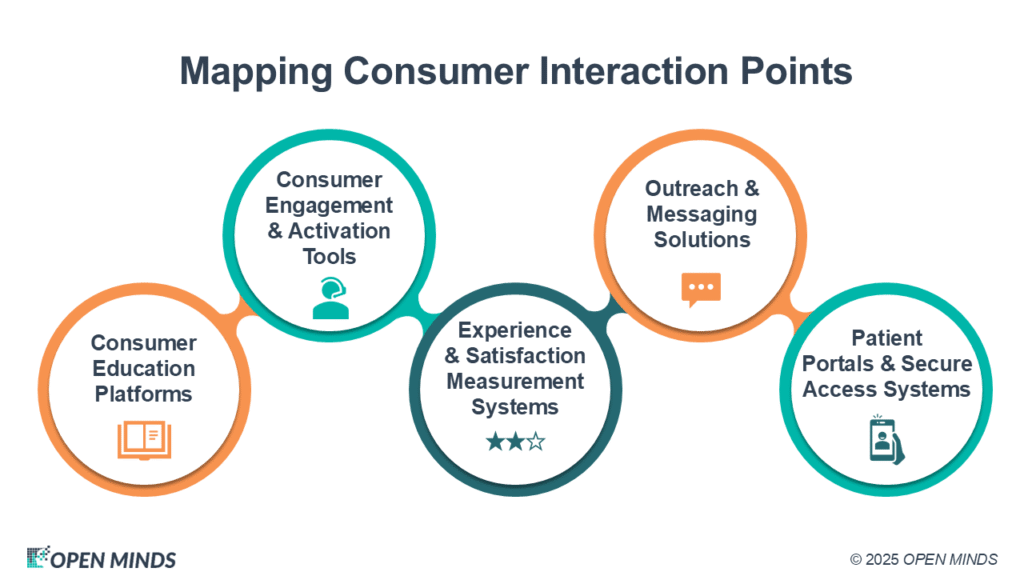
Consumer education platforms: Websites, videos, and awareness campaigns build visibility and trust, preparing consumers for engagement before their first encounter. Education materials build trust and enhance retention, extending positive financial outcomes from each consumer.
Consumer engagement and activation tools: These empower consumers to self-manage aspects of their care, from tracking progress to setting wellness goals, and strengthening commitment to the treatment process.
Experience and satisfaction measurement systems: Surveys and dashboards (including NPS and customer satisfaction score) provide continuous feedback loops and actionable data. When paired with sentiment analysis—the process of identifying and interpreting emotional tone in consumer feedback—they help identify service pain points before they affect retention.
Outreach and messaging solutions: Text and mobile communications ensure timely reminders and feedback collection, significantly reducing no-show rates and driving adherence.
Patient portals and secure access systems: These serve as the hub for all consumer interactions, enabling scheduling, messaging, payments, and data sharing through a single interface.
By linking these tools into a single digital architecture, organizations create a coherent brand experience that reinforces trust and loyalty.
Measuring Experience To Manage It
CFOs play a critical role in operationalizing consumer engagement. Measurement must extend beyond satisfaction to include metrics that directly correlate with financial and clinical performance, and compliance. Key indicators include:
- First-call resolution and response times: Measures the accessibility and responsiveness of the organization and use actionable data to drive change where needed.
- Days-to-appointment and no-show rates: Directly influence productivity and revenue, while meeting compliance targets and optimizing schedules. Managing no-shows helps support days-to-appointment.
- Social media engagement and conversion: Reflect public perception and supports marketing ROI through lead generation and consumer acquisition/retention.
- NPS: Serves as a proxy for brand loyalty and future growth.
These measures form the foundation of a Consumer Experience Performance Dashboard, which integrates operational, financial, and experiential data into a unified analytics platform. The CFO’s office should oversee this dashboard to ensure that consumer metrics inform budgeting, resource allocation, and performance incentives and that data, analytics, and metrics are understood by leadership and staff as critical to tracking and managing the organization.
Technology Alone Isn’t Enough
Not every tech solution fits every consumer or even the needs of every organization. The success of any technology initiative depends on CFOs and other stakeholder executive understanding three principles:
Consumer preferences: Demographic and behavioral differences mean that what works for one consumer group may not work for another. While older consumers may value phone contact and clear documentation, younger consumers prioritize mobile scheduling and chat communication. Executives must understand what their consumers want and will effectively adopt.
Technology integration into the care process: All technology investments must support clinical workflow. A “digital front door” that operates independently of care delivery will never meet the goals or deliver the necessary ROI. Executives must understand how to best deploy and support technology to support workflow before making the investment.
Staff and consumer support, training: Even the most advanced digital solutions require human reinforcement to achieve the required functionality and ROI. Executives must support and train care coordinators and front-line staff on how to guide consumers through new tools and ensure adoption.
As the market moves toward transparency, choice, and accountability, organizations must move beyond episodic service delivery to continuous engagement. And health plans and payers are already investing heavily in this area. Provider organizations that fail to match these efforts risk being left behind. Technology, thoughtfully deployed, can bridge that gap—but only if financial leaders ensure its embedded in strategy, operations, and culture.