
What lies ahead with the pending H.R.1 work requirements? The State of Nebraska, a state that implemented the work requirements in May 2026, gives us a preview.
As of the last count (through August 2026), 7.3% of Medicaid expansion beneficiaries undergoing renewal with the work requirements had their renewals denied – and 92.7% retained eligibility. A total of 557 Medicaid expansion applications were denied due to work requirements between May and August 2026 (see Nebraska Medicaid Advisory Committee September 17, 2026 Meeting Minutes). Of those denials, 466 (84%) resulted from applicants failing to provide the information needed to verify compliance or an exemption, rather than a determination that they did not meet the requirements.
The same pattern emerged in Nebraska Medicaid…
-
Management Newsletter Issue
|
Replicating Successful Programs – How To Scale What Works: The OPEN MINDS Management Newsletter, October 2026
-
Market Intel Report
|
The 2026 OPEN MINDS Executive Compensation & Retention Survey
-
Innovative Program Profile
|
Easterseals Southern California Severe Behavior Services Therapy: An OPEN MINDS Program Profile
RFPs
- California Seeks Expanded Learning Program Services
- Pennsylvania Seeks Mobile Application Services
- New Jersey’s Monmouth County Seeks Sexually Transmitted Disease Program Services
- Texas Seeks AEL High School Equivalency Virtual Provider Services
- New Mexico Seeks Coordinated Secure Notification Services
- Oklahoma Seeks Community Paramedicine Consulting Services
- North Carolina Seeks Direct Support Professional Core Competency Curriculum Services
- Michigan’s Jackson County Seeks Inmate Food Service Program
- Wyoming Seeks Media Campaign/Information Dissemination For State & Community Partner Networks
- New York’s City Of Rochester Seeks Drug & Alcohol Testing Services
Contract Awards
- Texas’ Kendall County Awards Inmate Health Care Services Contract To Southern Health Partners, Inc.
- Alaska Awards Mental Health Trust Authority Home & Community-Based Services Innovation & Reform Contract To HCBS Strategies, Inc.
- Virginia Awards Mobile Crisis Response Training Services Contract To Sargad, LLC
- Nebraska Awards Tobacco Quitline Services Contract To Consumer Wellness Solutions, Inc.
- Ohio’s Lucas County Awards Comprehensive Health Care Services For Incarcerated Individuals Contract To Armor Health Of Lucas County, LLC
Winning Proposals
- Texas’ Kendall County Awards Inmate Health Care Services Contract To Southern Health Partners, Inc.
- South Carolina’s Greenville County Awards Mental Health Services Contract To Bloom Behavioral Therapy
- Indiana Awards Special Education Alt License Services Contract To University Of Indianapolis
- Indiana Awards ACO Feasibility Study Services Contract To Deloitte Consulting, LLP
- Alaska Awards Mental Health Trust Authority Home & Community-Based Services Innovation & Reform Contract To HCBS Strategies, Inc.
On-Demand Webinars & Executive Roundtables
- What Works In Rural OUD Care: A Best Practice Case Study With St. Matthews Pharmacy & Spero Health
- ROI On Behavioral Health EHRs: What Today’s Leaders Are Overlooking
- From EHR To The Dosing Window: Transforming Opioid Treatment Through An Integrated Platform
- AI-Powered Personalization In Behavioral Health: Supporting Clinicians, Not Replacing Them
- Configuring Your EHR To Optimize Quality Data: Building the Foundation for Better Insights
Institute Presentations
- The CFO As System Architect: Rebuilding Finance Operations Around A New ERP
- Strategic Planning For Times Of Uncertainty: The 2026 OPEN MINDS Seminar On Nimble Data-Driven Planning
- Being An Executive Leader Is A Team Sport – Building Your Executive Team Bench Strength
- Clinical Excellence Best Practices: The 2026 OPEN MINDS Seminar On Engaging & Retaining Your Clinical Talent
- Mergers & Alliances: The Evolving Role of The CFO In Organizational Growth – M&A, Collaborations & Partnerships
Market Intelligence Reports
- The 2026 OPEN MINDS Executive Compensation & Retention Survey
- State Rates for Applied Behavior Analysis: An OPEN MINDS Market Intelligence Report
- Medicaid Utilization & Spending For Autism Spectrum Disorder: An OPEN MINDS Market Intelligence Report
- Colorado’s Behavioral Health Safety Net System: Pending Reimbursement Changes & Financial Trends, 2019-2026: An OPEN MINDS Market Intelligence Report
- Medicaid Foster Care Enrollment Updates, 2022-2024: An OPEN MINDS Market Intelligence Report
Upcoming Executive Events
Upcoming Institutes
-
The 2026 OPEN MINDS Technology & Analytics Institute
October 27 – October 29, 2026 – Philadelphia, Pennsylvania
-
The 2027 OPEN MINDS Performance Management Institute
February 16 – February 18, 2027 – Clearwater Beach, Florida
-
The 2027 OPEN MINDS Strategy & Innovation Institute
June 08 – June 10, 2027 – New Orleans, Louisiana
-
The 2027 OPEN MINDS Service Excellence Institute
August 17 – August 19, 2027 – San Francisco, California
-
The 2027 OPEN MINDS Executive Leadership Retreat
September 21 – September 23, 2027 – Gettysburg, Pennsylvania
Upcoming Executive Summits
-
The 2026 OPEN MINDS CEO Tech & AI Summit
October 28, 2026 – Philadelphia, Pennsylvania -
The 2026 OPEN MINDS Addiction & SUD Summit
October 29, 2026 – Philadelphia, Pennsylvania -
The 2027 OPEN MINDS CFO Summit
February 18, 2027 – Clearwater Beach, Florida -
The 2027 OPEN MINDS Workforce AI Summit
February 17, 2027 – Clearwater Beach, Florida -
The 2027 OPEN MINDS Autism & I/DD Summit
June 9, 2027 – New Orleans, Louisiana -
The 2027 OPEN MINDS Future Of Aging Services
June 10, 2027 – New Orleans, Louisiana -
The 2027 OPEN MINDS Addiction & SUD Executive Summit
August 18, 2027 – San Francisco, California
Upcoming Best Practice Seminars
-
Finding An EHR For Your Future: The 2026 OPEN MINDS Best Practices Seminar On EHR Selection, Implementation & Optimization
October 27, 2026 – Philadelphia, Pennsylvania -
Creating A Winning Tech Strategy: The 2026 OPEN MINDS Seminar On Building A Digital Transformation Roadmap
October 27, 2026 – Philadelphia, Pennsylvania -
Building A Data-Driven Organization: The 2027 OPEN MINDS Seminar On Choosing What To Measure & What To Retire
February 16, 2027 – Clearwater Beach, Florida -
Revenue Beyond Health Plans: The 2027 OPEN MINDS Seminar On Diversifying Revenue Sources
February 16, 2027 – Clearwater Beach, Florida -
M&A Strategy For A Shifting Market: The 2027 OPEN MINDS Seminar On Buying, Partnering, Or Being Bought
June 8, 2027 – New Orleans, Louisiana -
Creating A Winning Tech Strategy: The 2027 OPEN MINDS Seminar On What To Buy & Who Governs It
June 8, 2027 – New Orleans, Louisiana -
Health Plan Contracting: The 2027 OPEN MINDS Seminar On Managing The Contracts You Have & Pricing New Ones
August 17, 2027 – San Francisco, California -
Which Service Lines Earn Their Place: The 2027 OPEN MINDS Executive Seminar On Service Line Portfolio Decisions
August 17, 2027 – San Francisco, California
Upcoming Webinars
-
Preparing For H.R.1: Managing Medicaid Eligibility, Redeterminations & Access To Care
November 4, 2026 – Virtual Event -
Driving Revenue Resilience with Smarter, AI-Powered Benefits Coordination
November 5, 2026 – Virtual Event -
AI For Good: Building A Safe, Trusted, & Proven AI Strategy For Behavioral Health
November 12, 2026 – Virtual Event -
Your Next Move: Program Expansion, M&A, Or Both?
December 9, 2026 – Virtual Event
Upcoming Circle Elite Executive Roundtables
-
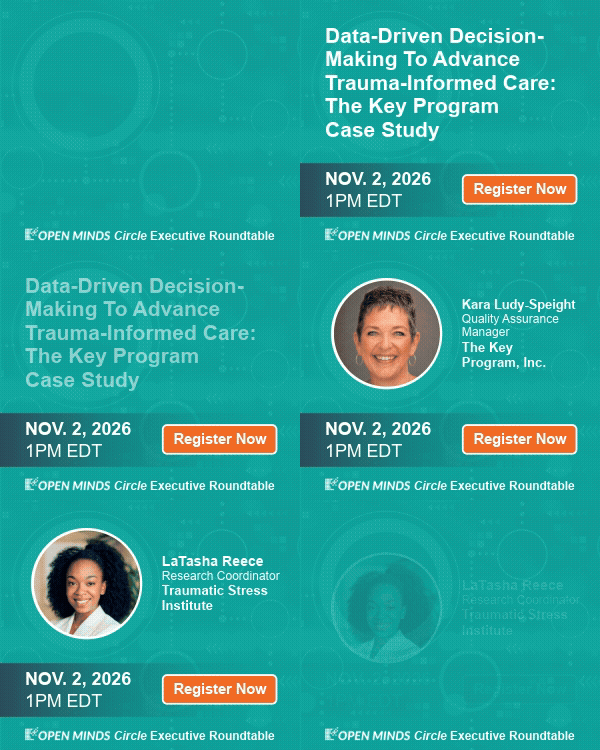
Data-Driven Decision-Making To Advance Trauma-Informed Care: The Key Program Case Study
November 2, 2026 – Virtual Event -
Reimagining Involuntary Crisis Response Through Partnership: The Connections & Prince William County Case Study
November 9, 2026 – Virtual Event -
Expanding A Proven Mobile Crisis Model To Multiple States: The Benchmark Human Services Case Study
November 16, 2026 – Virtual Event -
An Integrated Model For Better Outcomes, Lower Utilization & Lower Costs: The Mental Health Cooperative Case Study
December 7, 2026 – Virtual Event -
Standing Up A Successful Health Navigator Program: The Circle the City Case Study
December 14, 2026 – Virtual Event
Innovative Program Profiles
- Easterseals Southern California Severe Behavior Services Therapy: An OPEN MINDS Program Profile
- Canopy Adult Autism Program By Giant Steps: An OPEN MINDS Program Profile
- Community Action Treatment (CAT) Team By Bridgeway Center, Inc.: An OPEN MINDS Program Profile
- Case Management Programs By Benchmark Human Services: An OPEN MINDS Program Profile
- Project For Assistance In Transition From Homelessness (PATH) By Coastal Horizons Center: An OPEN MINDS Program Profile


News Wire
- Suicide Becomes The 10th Leading Cause Of Death In The U.S.
- Seattle & King County To Take Over $150 Million In Annual Homelessness-Service Contracts
- New Research Definition Proposed For Profound Autism
- 16.8% Of U.S. Adolescents Report Moderate Or Severe Anxiety Symptoms
- Under 10% Of Calls To Commercial Health Plan Mental Health Providers Resulted In Appointments
- eSteps Decision-Support Tool Associated With 9% Lower Fall Rate Among Older Adults
- Illinois Nursing Home Sues CMS Over Schizophrenia Audit & Quality Rating Downgrade
Market Updates
- Catalight Academy Online Learning Platform Launches Courses For Parents Of Autistic Youth
- HealthPartners Launches Program To Expand Access To CGM Technology For People Living With Diabetes
- Canary Speech & VillageFor Partner To Bring Voice-Based Mental Wellness Check-Ins To Support Maternal Mental Health
- Otter Health Launches With $8 Million To Build A New Era Of Utilization & Quality Management Beyond Prior Authorization
- Rural Health Care Organization In Indiana, Parkview Health, To Acquire Shared Services Provider Ovation Healthcare
Management Newsletter
Industry Resources
- Proposed Rule: Medicare Program; Implementation Of Sections 6219, 6220, & 6224 Of The Consolidated Appropriations Act, 2026
- CMS Frequently Asked Questions (FAQs) & Enrollment Scenarios For § 422.514(h): Fully Aligned D-SNPs & Medicaid MCOs
- Code of Federal Regulations Title 42, Chapter IV, Subchapter B, Part 422, Subpart K, § 422.514: Enrollment Requirements
- Update To The New York State Medicaid Telehealth Policy Manual, Volume 42 | Number 9
- Executive Order: Addressing Addiction Through The Great American Recovery Initiative
- New York City Department For The Aging Social Adult Day Care Ombuds Office LL9 Annual Report 2025
- Crushing Fraud 2026: CMS Facts & Figures, January 1, 2026 – June 30, 2026