
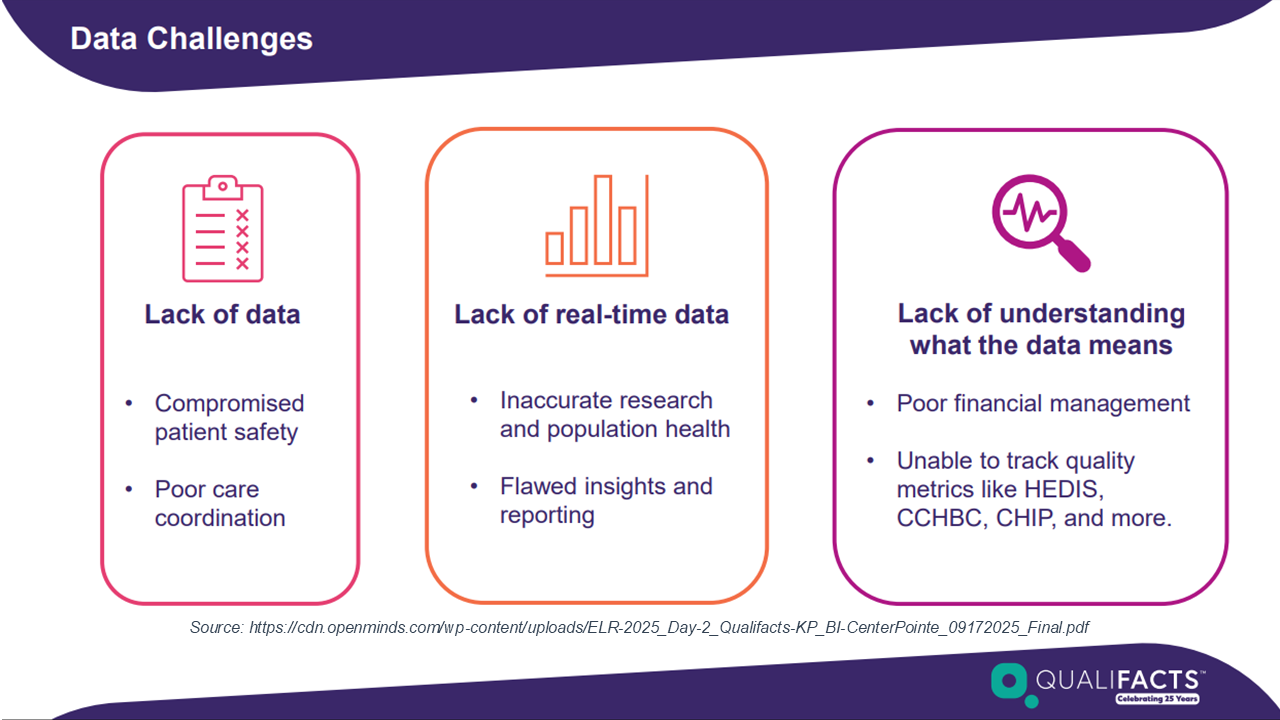
What is a ‘good outcome’ for people with behavioral and cognitive disabilities? The data – and the standards – are all over the map.
Even as the requirements around medical necessity, documentation, and billing get more stringent, there’s still no broadly accepted agreement on what defines a ‘good outcome’ and how to measure it.
When it comes to outcomes management, every stakeholder wants (and needs) something different. Payers want value for health care expenditures. Health plans are looking for a lower total cost of care – often translated into lower use of emergency rooms, fewer readmissions, and better Healthcare Effectiveness Data and Information Set (HEDIS) scores. Consumers want to achieve their personal life goals, as unaffected by their health care condition as…
-
Management Newsletter Issue
|
Replicating Successful Programs – How To Scale What Works: The OPEN MINDS Management Newsletter, October 2026
-
Market Intel Report
|
The 2026 OPEN MINDS Executive Compensation & Retention Survey
-
Innovative Program Profile
|
Easterseals Southern California Severe Behavior Services Therapy: An OPEN MINDS Program Profile

RFPs
- Massachusetts Seeks Enrollment & Marketing Support Services
- California’s Yuba County Seeks Consulting Services For CalWORKs Outcomes & Accountability Review (CalOAR) Continuous Quality Improvement (CQI) Project
- Pennsylvania’s City Of Philadelphia Seeks Injury Prevention Program Services
- Federal Government Announces NLM Institutional Grants For Research Training In Biomedical Informatics, Data Science & AI (T15 Independent Clinical Trial Not Allowed) Funding
- Pennsylvania’s Montgomery County Seeks Psychiatric, Psychological & Specialized Evaluation Services
- New York’s Broome County Seeks First Three Child Care Extension Pilot Services
- Missouri’s City Of St. Louis Seeks Domestic Violence Shelter Services
- North Carolina’s Forsyth County Seeks Medical/Drug Screenings & Psychological Evaluation Services
- California’s Residential Treatment & Residential With Support Services For Adults & Elderly
- Indiana’s City Of Indianapolis Seeks Inmate Transportation Services
Contract Awards
- Texas’ Kendall County Awards Inmate Health Care Services Contract To Southern Health Partners, Inc.
- Alaska Awards Mental Health Trust Authority Home & Community-Based Services Innovation & Reform Contract To HCBS Strategies, Inc.
- Virginia Awards Mobile Crisis Response Training Services Contract To Sargad, LLC
- Nebraska Awards Tobacco Quitline Services Contract To Consumer Wellness Solutions, Inc.
- Ohio’s Lucas County Awards Comprehensive Health Care Services For Incarcerated Individuals Contract To Armor Health Of Lucas County, LLC
Winning Proposals
- Texas’ Kendall County Awards Inmate Health Care Services Contract To Southern Health Partners, Inc.
- South Carolina’s Greenville County Awards Mental Health Services Contract To Bloom Behavioral Therapy
- Indiana Awards Special Education Alt License Services Contract To University Of Indianapolis
- Indiana Awards ACO Feasibility Study Services Contract To Deloitte Consulting, LLP
- Alaska Awards Mental Health Trust Authority Home & Community-Based Services Innovation & Reform Contract To HCBS Strategies, Inc.
On-Demand Webinars & Executive Roundtables
- What Works In Rural OUD Care: A Best Practice Case Study With St. Matthews Pharmacy & Spero Health
- ROI On Behavioral Health EHRs: What Today’s Leaders Are Overlooking
- From EHR To The Dosing Window: Transforming Opioid Treatment Through An Integrated Platform
- AI-Powered Personalization In Behavioral Health: Supporting Clinicians, Not Replacing Them
- Configuring Your EHR To Optimize Quality Data: Building the Foundation for Better Insights
Institute Presentations
- The CFO As System Architect: Rebuilding Finance Operations Around A New ERP
- Strategic Planning For Times Of Uncertainty: The 2026 OPEN MINDS Seminar On Nimble Data-Driven Planning
- Being An Executive Leader Is A Team Sport – Building Your Executive Team Bench Strength
- Clinical Excellence Best Practices: The 2026 OPEN MINDS Seminar On Engaging & Retaining Your Clinical Talent
- Mergers & Alliances: The Evolving Role of The CFO In Organizational Growth – M&A, Collaborations & Partnerships
Market Intelligence Reports
- The 2026 OPEN MINDS Executive Compensation & Retention Survey
- State Rates for Applied Behavior Analysis: An OPEN MINDS Market Intelligence Report
- Medicaid Utilization & Spending For Autism Spectrum Disorder: An OPEN MINDS Market Intelligence Report
- Colorado’s Behavioral Health Safety Net System: Pending Reimbursement Changes & Financial Trends, 2019-2026: An OPEN MINDS Market Intelligence Report
- Medicaid Foster Care Enrollment Updates, 2022-2024: An OPEN MINDS Market Intelligence Report
Upcoming Executive Events
Upcoming Institutes
-
The 2026 OPEN MINDS Technology & Analytics Institute
October 27 – October 29, 2026 – Philadelphia, Pennsylvania
-
The 2027 OPEN MINDS Performance Management Institute
February 16 – February 18, 2027 – Clearwater Beach, Florida
-
The 2027 OPEN MINDS Strategy & Innovation Institute
June 08 – June 10, 2027 – New Orleans, Louisiana
-
The 2027 OPEN MINDS Service Excellence Institute
August 17 – August 19, 2027 – San Francisco, California
-
The 2027 OPEN MINDS Executive Leadership Retreat
September 21 – September 23, 2027 – Gettysburg, Pennsylvania
Upcoming Executive Summits
-
The 2026 OPEN MINDS CEO Tech & AI Summit
October 28, 2026 – Philadelphia, Pennsylvania -
The 2026 OPEN MINDS Addiction & SUD Summit
October 29, 2026 – Philadelphia, Pennsylvania -
The 2027 OPEN MINDS CFO Summit
February 18, 2027 – Clearwater Beach, Florida -
The 2027 OPEN MINDS Workforce AI Summit
February 17, 2027 – Clearwater Beach, Florida -
The 2027 OPEN MINDS Autism & I/DD Summit
June 9, 2027 – New Orleans, Louisiana -
The 2027 OPEN MINDS Future Of Aging Services
June 10, 2027 – New Orleans, Louisiana -
The 2027 OPEN MINDS Addiction & SUD Executive Summit
August 18, 2027 – San Francisco, California
Upcoming Best Practice Seminars
-
Finding An EHR For Your Future: The 2026 OPEN MINDS Best Practices Seminar On EHR Selection, Implementation & Optimization
October 27, 2026 – Philadelphia, Pennsylvania -
Creating A Winning Tech Strategy: The 2026 OPEN MINDS Seminar On Building A Digital Transformation Roadmap
October 27, 2026 – Philadelphia, Pennsylvania -
Building A Data-Driven Organization: The 2027 OPEN MINDS Seminar On Choosing What To Measure & What To Retire
February 16, 2027 – Clearwater Beach, Florida -
Revenue Beyond Health Plans: The 2027 OPEN MINDS Seminar On Diversifying Revenue Sources
February 16, 2027 – Clearwater Beach, Florida -
M&A Strategy For A Shifting Market: The 2027 OPEN MINDS Seminar On Buying, Partnering, Or Being Bought
June 8, 2027 – New Orleans, Louisiana -
Creating A Winning Tech Strategy: The 2027 OPEN MINDS Seminar On What To Buy & Who Governs It
June 8, 2027 – New Orleans, Louisiana -
Health Plan Contracting: The 2027 OPEN MINDS Seminar On Managing The Contracts You Have & Pricing New Ones
August 17, 2027 – San Francisco, California -
Which Service Lines Earn Their Place: The 2027 OPEN MINDS Executive Seminar On Service Line Portfolio Decisions
August 17, 2027 – San Francisco, California
Upcoming Webinars
-
Preparing For H.R.1: Managing Medicaid Eligibility, Redeterminations & Access To Care
November 4, 2026 – Virtual Event -
Driving Revenue Resilience with Smarter, AI-Powered Benefits Coordination
November 5, 2026 – Virtual Event -
AI For Good: Building A Safe, Trusted, & Proven AI Strategy For Behavioral Health
November 12, 2026 – Virtual Event -
Your Next Move: Program Expansion, M&A, Or Both?
December 9, 2026 – Virtual Event
Upcoming Circle Elite Executive Roundtables
-
Data-Driven Decision-Making To Advance Trauma-Informed Care: The Key Program Case Study
November 2, 2026 – Virtual Event -
Reimagining Involuntary Crisis Response Through Partnership: The Connections & Prince William County Case Study
November 9, 2026 – Virtual Event -
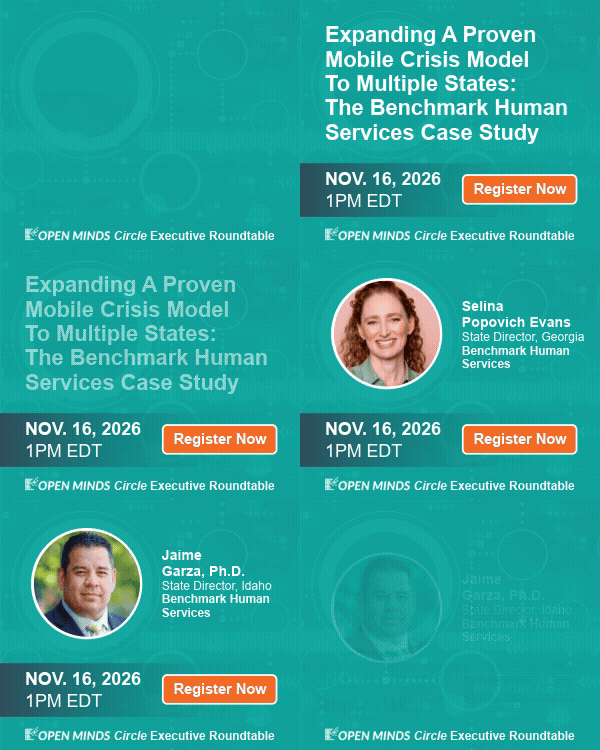
Expanding A Proven Mobile Crisis Model To Multiple States: The Benchmark Human Services Case Study
November 16, 2026 – Virtual Event -
An Integrated Model For Better Outcomes, Lower Utilization & Lower Costs: The Mental Health Cooperative Case Study
December 7, 2026 – Virtual Event -
Standing Up A Successful Health Navigator Program: The Circle the City Case Study
December 14, 2026 – Virtual Event
Innovative Program Profiles
- Easterseals Southern California Severe Behavior Services Therapy: An OPEN MINDS Program Profile
- Canopy Adult Autism Program By Giant Steps: An OPEN MINDS Program Profile
- Community Action Treatment (CAT) Team By Bridgeway Center, Inc.: An OPEN MINDS Program Profile
- Case Management Programs By Benchmark Human Services: An OPEN MINDS Program Profile
- Project For Assistance In Transition From Homelessness (PATH) By Coastal Horizons Center: An OPEN MINDS Program Profile


News Wire
- Kidney Transplant Rates Lower For Medicare Advantage Than Traditional Medicare
- Rhode Island Seeks Up To Three Health Plans For Integrated Medicare & Medicaid Program
- Michigan Sues Blue Cross Blue Shield Over Alleged Anticompetitive Practices & Low Provider Reimbursement
- Nebraska Denies Medicaid Coverage To 1,090 Applicants & Beneficiaries Under New Work Requirements
- 71% Of Medicare Advantage Prescription Drug Plan Enrollees In Four- Or Five-Star Plans For 2027
- Suicide Attempts Among U.S. High School Students Decline Between 2023 & 2025
- Illinois Implements New Child Welfare Safety Assessment Model To Guide Investigations & Family Support
Market Updates
- Health Innovation South West & Helfie AI Partner To Evaluate Digital-First Hypertension Screening
- Andor Health & Psynergy Health Launch Tech-Enabled Chronic Care Clinic For The Medicare ACCESS Program
- VitalCore Supports Opening Of New 60-Bed Behavioral Health Unit At Shawnee County Jail In Topeka
- Tecsys Pledges $5 Million To Prisma Health’s New Behavioral Health Hospital In South Carolina
- Connecticut Awarded $50 Million To Optimize Care Delivery & Improve Rural Hospital Infrastructure
Management Newsletter
Industry Resources
- New York City Department For The Aging Social Adult Day Care Ombuds Office LL9 Annual Report 2025
- Crushing Fraud 2026: CMS Facts & Figures, January 1, 2026 – June 30, 2026
- Forest City Rehab & Nursing Center, LLC v. Mehmet Oz
- Deaths: Leading Causes For 2024
- Final Rule: Statement Of Delegation Of Authority
- CMS Response In Forest City Rehab & Nursing Center, LLC v. Mehmet Oz
- In Re: Character Technologies, Inc., Debtor