
Getting claims out the door is one thing. Getting cash in the bank is another.
The good news: Initial claim denial rates declined from 12.00% in the first half of 2025 to 10.63% in the first half of 2026 according to a new study, Unyielding Denials. Final denial write-offs also declined, from 3.31% to 3.07% of net revenue.
The problem: Lower denial rates have not converted into higher net revenue, or yield. Cash payment rates declined to 50.2% and 96.7% within 30 and 60 days, respectively. At the same time, health plan takebacks after payment increased from 1.36% to 1.57% of accounts receivable.
In a market where margins are tight and there is increasing scrutiny of claims, the…
-
Management Newsletter Issue
|
Replicating Successful Programs – How To Scale What Works: The OPEN MINDS Management Newsletter, October 2026
-
Market Intel Report
|
The 2026 OPEN MINDS Executive Compensation & Retention Survey
-
Innovative Program Profile
|
Easterseals Southern California Severe Behavior Services Therapy: An OPEN MINDS Program Profile

RFPs
- California’s City Of Lakeport Seeks Business Financial Assistance Program Services For State Community Development Block Grant (CDBG) & Other State & Federal Program Funding
- California Seeks Consulting Services Cardiologist
- New York Seeks Medical Coding Services
- Virginia Seeks Oracle Health Patient Accounting (OHPAC) Trainer Services
- Colorado’s Boulder County Seeks Electronic Health Record System With Medicaid Billing
- Massachusetts Seeks Children & Family Law Division & Mental Health Litigation Division Attorney Workload Study Services
- Washington Seeks Public Health Nurse Pilot Services
- California Seeks Non-Emergency Ambulance Transportation Services
- New Jersey’s City Of Camden Seeks Occupational Health Care For Pre-Employment Physicals Including Initial Drug/Alcohol Screening & Return To Work Evaluations For Non-Work Related Injuries
- Florida Seeks Workers Compensation Claims Third-Party Claims Administration Services
Contract Awards
- Texas’ Kendall County Awards Inmate Health Care Services Contract To Southern Health Partners, Inc.
- Alaska Awards Mental Health Trust Authority Home & Community-Based Services Innovation & Reform Contract To HCBS Strategies, Inc.
- Virginia Awards Mobile Crisis Response Training Services Contract To Sargad, LLC
- Nebraska Awards Tobacco Quitline Services Contract To Consumer Wellness Solutions, Inc.
- Ohio’s Lucas County Awards Comprehensive Health Care Services For Incarcerated Individuals Contract To Armor Health Of Lucas County, LLC
Winning Proposals
- Texas’ Kendall County Awards Inmate Health Care Services Contract To Southern Health Partners, Inc.
- South Carolina’s Greenville County Awards Mental Health Services Contract To Bloom Behavioral Therapy
- Indiana Awards Special Education Alt License Services Contract To University Of Indianapolis
- Indiana Awards ACO Feasibility Study Services Contract To Deloitte Consulting, LLP
- Alaska Awards Mental Health Trust Authority Home & Community-Based Services Innovation & Reform Contract To HCBS Strategies, Inc.
On-Demand Webinars & Executive Roundtables
- What Works In Rural OUD Care: A Best Practice Case Study With St. Matthews Pharmacy & Spero Health
- ROI On Behavioral Health EHRs: What Today’s Leaders Are Overlooking
- From EHR To The Dosing Window: Transforming Opioid Treatment Through An Integrated Platform
- AI-Powered Personalization In Behavioral Health: Supporting Clinicians, Not Replacing Them
- Configuring Your EHR To Optimize Quality Data: Building the Foundation for Better Insights
Institute Presentations
- The CFO As System Architect: Rebuilding Finance Operations Around A New ERP
- Strategic Planning For Times Of Uncertainty: The 2026 OPEN MINDS Seminar On Nimble Data-Driven Planning
- Being An Executive Leader Is A Team Sport – Building Your Executive Team Bench Strength
- Clinical Excellence Best Practices: The 2026 OPEN MINDS Seminar On Engaging & Retaining Your Clinical Talent
- Mergers & Alliances: The Evolving Role of The CFO In Organizational Growth – M&A, Collaborations & Partnerships
Market Intelligence Reports
- The 2026 OPEN MINDS Executive Compensation & Retention Survey
- State Rates for Applied Behavior Analysis: An OPEN MINDS Market Intelligence Report
- Medicaid Utilization & Spending For Autism Spectrum Disorder: An OPEN MINDS Market Intelligence Report
- Colorado’s Behavioral Health Safety Net System: Pending Reimbursement Changes & Financial Trends, 2019-2026: An OPEN MINDS Market Intelligence Report
- Medicaid Foster Care Enrollment Updates, 2022-2024: An OPEN MINDS Market Intelligence Report
Upcoming Executive Events
Upcoming Institutes
-
The 2026 OPEN MINDS Technology & Analytics Institute
October 27 – October 29, 2026 – Philadelphia, Pennsylvania
-
The 2027 OPEN MINDS Performance Management Institute
February 16 – February 18, 2027 – Clearwater Beach, Florida
-
The 2027 OPEN MINDS Strategy & Innovation Institute
June 08 – June 10, 2027 – New Orleans, Louisiana
-
The 2027 OPEN MINDS Service Excellence Institute
August 17 – August 19, 2027 – San Francisco, California
-
The 2027 OPEN MINDS Executive Leadership Retreat
September 21 – September 23, 2027 – Gettysburg, Pennsylvania
Upcoming Executive Summits
-
The 2026 OPEN MINDS CEO Tech & AI Summit
October 28, 2026 – Philadelphia, Pennsylvania -
The 2026 OPEN MINDS Addiction & SUD Summit
October 29, 2026 – Philadelphia, Pennsylvania -
The 2027 OPEN MINDS CFO Summit
February 18, 2027 – Clearwater Beach, Florida -
The 2027 OPEN MINDS Workforce AI Summit
February 17, 2027 – Clearwater Beach, Florida -
The 2027 OPEN MINDS Autism & I/DD Summit
June 9, 2027 – New Orleans, Louisiana -
The 2027 OPEN MINDS Future Of Aging Services
June 10, 2027 – New Orleans, Louisiana -
The 2027 OPEN MINDS Addiction & SUD Executive Summit
August 18, 2027 – San Francisco, California
Upcoming Best Practice Seminars
-
Building A Data-Driven Organization: The 2027 OPEN MINDS Seminar On Choosing What To Measure & What To Retire
February 16, 2027 – Clearwater Beach, Florida -
Revenue Beyond Health Plans: The 2027 OPEN MINDS Seminar On Diversifying Revenue Sources
February 16, 2027 – Clearwater Beach, Florida -
M&A Strategy For A Shifting Market: The 2027 OPEN MINDS Seminar On Buying, Partnering, Or Being Bought
June 8, 2027 – New Orleans, Louisiana -
Creating A Winning Tech Strategy: The 2027 OPEN MINDS Seminar On What To Buy & Who Governs It
June 8, 2027 – New Orleans, Louisiana -
Health Plan Contracting: The 2027 OPEN MINDS Seminar On Managing The Contracts You Have & Pricing New Ones
August 17, 2027 – San Francisco, California -
Which Service Lines Earn Their Place: The 2027 OPEN MINDS Executive Seminar On Service Line Portfolio Decisions
August 17, 2027 – San Francisco, California
Upcoming Webinars
-
Preparing For H.R.1: Managing Medicaid Eligibility, Redeterminations & Access To Care
November 4, 2026 – Virtual Event -
Driving Revenue Resilience with Smarter, AI-Powered Benefits Coordination
November 5, 2026 – Virtual Event -
AI For Good: Building A Safe, Trusted, & Proven AI Strategy For Behavioral Health
November 12, 2026 – Virtual Event -
Your Next Move: Program Expansion, M&A, Or Both?
December 9, 2026 – Virtual Event
Upcoming Circle Elite Executive Roundtables
-
Data-Driven Decision-Making To Advance Trauma-Informed Care: The Key Program Case Study
November 2, 2026 – Virtual Event -
Reimagining Involuntary Crisis Response Through Partnership: The Connections & Prince William County Case Study
November 9, 2026 – Virtual Event -
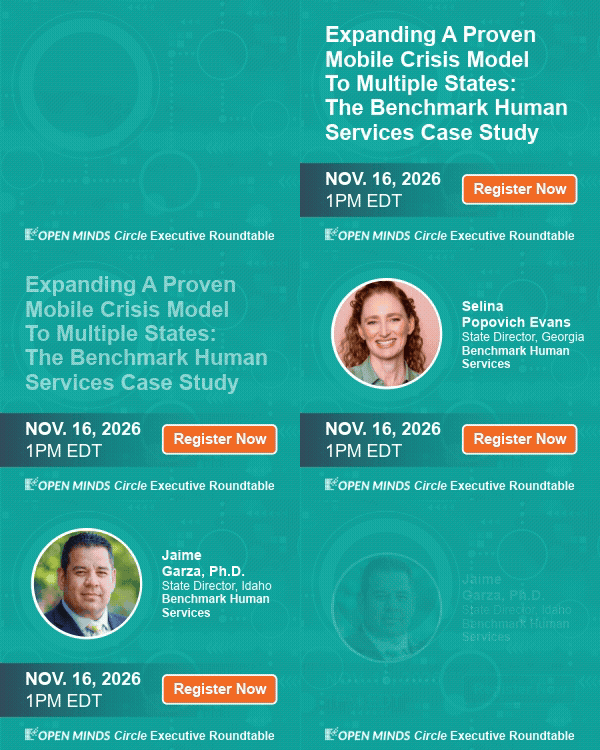
Expanding A Proven Mobile Crisis Model To Multiple States: The Benchmark Human Services Case Study
November 16, 2026 – Virtual Event -
An Integrated Model For Better Outcomes, Lower Utilization & Lower Costs: The Mental Health Cooperative Case Study
December 7, 2026 – Virtual Event -
Standing Up A Successful Health Navigator Program: The Circle the City Case Study
December 14, 2026 – Virtual Event
Innovative Program Profiles
- Easterseals Southern California Severe Behavior Services Therapy: An OPEN MINDS Program Profile
- Canopy Adult Autism Program By Giant Steps: An OPEN MINDS Program Profile
- Community Action Treatment (CAT) Team By Bridgeway Center, Inc.: An OPEN MINDS Program Profile
- Case Management Programs By Benchmark Human Services: An OPEN MINDS Program Profile
- Project For Assistance In Transition From Homelessness (PATH) By Coastal Horizons Center: An OPEN MINDS Program Profile


News Wire
- Suicide Becomes The 10th Leading Cause Of Death In The U.S.
- Seattle & King County To Take Over $150 Million In Annual Homelessness-Service Contracts
- New Research Definition Proposed For Profound Autism
- 16.8% Of U.S. Adolescents Report Moderate Or Severe Anxiety Symptoms
- Under 10% Of Calls To Commercial Health Plan Mental Health Providers Resulted In Appointments
- eSteps Decision-Support Tool Associated With 9% Lower Fall Rate Among Older Adults
- Illinois Nursing Home Sues CMS Over Schizophrenia Audit & Quality Rating Downgrade
Market Updates
- Synapticure Launches Ataxia Care Program, Expanding Access To Specialized Neurology In The U.S.
- Ochsner Health Partners With Joy 101 To Strengthen Workforce Well-Being & Culture
- Rutgers & RWJBarnabas Health To Launch Innovation Hub, Powered By Amazon Web Services
- New Mexico Awarded $74 Million In Federal Funding To Expand Rural Specialty, Maternal & Behavioral Health Care
- Non-Profit Advantage Services In Utah On Brink Of Bankruptcy, Furloughs 110 & Issues ‘Urgent’ Call For Help
Management Newsletter
Industry Resources
- Medicaid Program – Oversight Of Social Adult Day Care Programs
- New York City Department For The Aging Social Adult Day Care Ombuds Office LL9 Annual Report 2025
- North Carolina Chief Justice’s Task Force On ACEs-Informed Courts
- Proposed Rule: Medicare Program; Implementation Of Sections 6219, 6220, & 6224 Of The Consolidated Appropriations Act, 2026
- CMS Frequently Asked Questions (FAQs) & Enrollment Scenarios For § 422.514(h): Fully Aligned D-SNPs & Medicaid MCOs
- Code of Federal Regulations Title 42, Chapter IV, Subchapter B, Part 422, Subpart K, § 422.514: Enrollment Requirements
- Update To The New York State Medicaid Telehealth Policy Manual, Volume 42 | Number 9